You may listen to this post read aloud by the author or read it for yourself below:
I almost drowned.
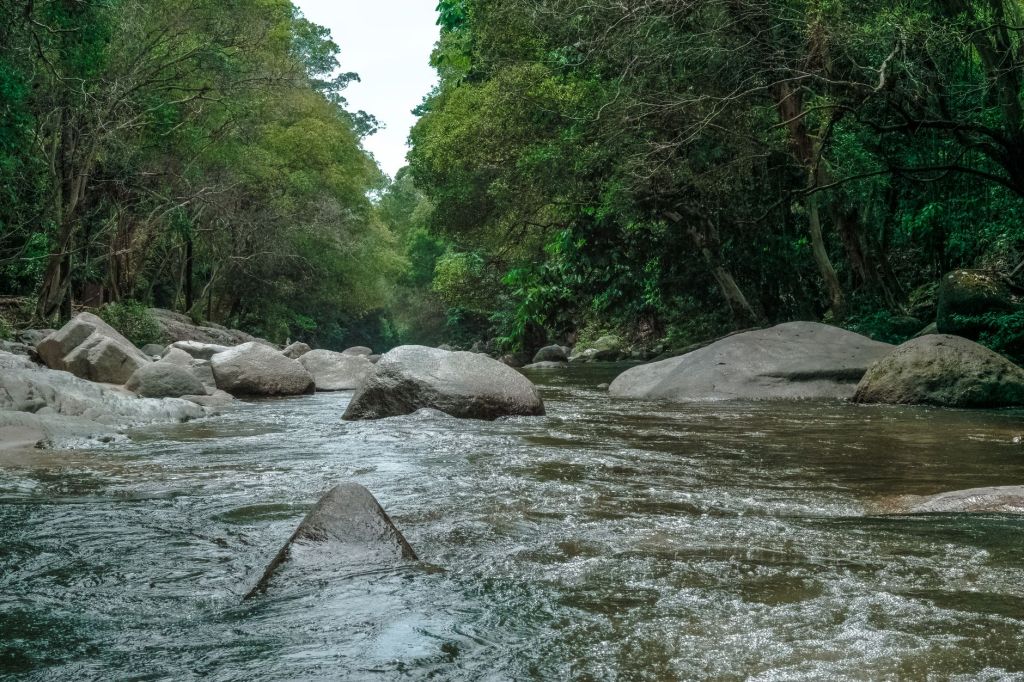
I had been tubing down some man-made rapids in the center of my hometown over Fourth of July. My third trip through the water, sun bathed my skin, my screaming five-year-old had been left behind with dad to explore the riverbank, and I leaned back in the tube, closing my eyes and soaking up every moment of delicious peace in nature. When I traveled through the last rapid, I slipped out of my tube on the other side—just as I had done the two times before—so I could more easily navigate to the other side of the stream. The intention was to climb out the low-lying rocks beside the trail that led back through the park. But this time my Chaco sandal wedged between two submerged rocks and stuck fast.
At first my head remained above water. The depth only came to my chest, but I was close enough to the overflow of the rapid that the current was strong. My first concern was for my sandal. I’ve worn those Chacos through the past sixteen summers. They’ve carried me through slums of India and forded ice-cold Colorado streams. I’ve had them re-strapped and re-soled. They cushion my feet with support I’m not sure I can recreate and a host of memories that make me feel like me. Yet now they were betraying me.
I reached down to loosen my foot and found myself pulled underwater.
I struggled to regain my balance and reclaim the surface. Surely I was fine. But as the seconds passed and the water churned around me, my breath began to thin. Panic started to rise. This is it, I thought as the fear became vivid. This could be the end.
“Consider your death every day,”
is the section from Michael Easter’s book The Comfort Crisis that has stuck with me the most. He describes how much work we do as Westerners to avoid and distance ourselves from death—from thinking about it, preparing for it, encountering it. But before modern hospitals and nursing facilities and funeral parlors with contemporary embalming practices, we were all forced to live much closer to death. This distance has not made us happier. Easter travels to Bhutan as he researches his book because “despite being ranked 134 on the list of most-developed nations on earth, extensive studies conducted by Japanese researchers have found that Bhutan is among the worlds’ 20 happiest countries” (188). The main reason is because “the understanding that we’re all going to die is hammered into Bhutan’s collective consciousness. Death is a part of everyday life” (188).
As Easter sits and visits with a spiritual lama in Bhutan he recognizes, “When a person realizes death is imminent, their checklist and everyday bullshit becomes irrelevant and their mind begins to center on that which makes it happy. Research from Australia found that the top regrets of the dying include not living in the moment, working too often, and living a life the person thinks they should rather than the one they truly want to” (201).
“’Whereas those who have thought of their death and prepared for it,’ said the lama, ‘they do not have those regrets. Because they have often not fallen so much into those delusions. They have lived in the moment. Maybe they have accomplished a lot, maybe they have not. But regardless it has not affected their happiness as much…’” (201).
I experience some version of this knowledge in my minute below the water.
Faced with the possibility I might not emerge, it is my children and my husband I think of most. I realize I am not afraid to die, but their pain and loss of connection I hold tenderly. As my lungs strain, my body reaches for spirit—breath—to fill them again. Lord have mercy.
I come up from the water, the force of the current eventually helping to pull the sole of my Chaco free. I break the surface spluttering and then swim after my tube floating away downstream. I realize my seven-year-old has been watching me wide-eyed from across the stream. My sister had her back turned and missed the whole ordeal. I want to brush it off, not scare anyone. But my legs shake as I crawl out of the water and feel the ground beneath my feet.
Part of me instantly wondered if I’d done something wrong. Should I not have gone tubing? But I quickly discard that notion. Tubing was good for my soul. Being outside and in the water, doing something adventurous, enjoying an experience with my family. These were all things that made me feel alive and whole, connected to the earth. I would do them all over again. But as I walked back up the path to my husband and five-year-old, I walked with the awareness that seeing them again was a gift. Could they understand what we held was almost shattered?
A Different Meaning of Death
Meggan Watterson, in her book Mary Magdalene Revealed, writes, “In Aramaic, the language Christ spoke, the word death means ‘existing elsewhere’” (69). The prevailing notion of death and the afterlife (according to Western Christian tradition) would align with this thought. When you die—so people think—you go to be somewhere else. You are no longer here. But this definition has grabbed me in an entirely different way. How often am I living in death every day? How often am I elsewhere? Not present? Worried about the past or the future instead of grounded in the now. How much of my life do I spend in a living death, like a type of ghost, haunting this space where I walk without fully embodying it?
So the invitation to consider your death every day might have two meanings. Consider that your body will die one day. You will leave this physical plane of existence. But also, consider how you experience death every day—all the small ones where you miss the opportunity to show up fully in the here and now.
This invitation is not meant to cause one to dwell on all the ways life could go wrong. I watch a lot of people in our culture live and parent out of a place of anxiety. I have those days too. Am I doing it right? What if something bad happens? But I refuse to allow my anxiety to become paralyzing and keep me from really living and giving my kids what they need to thrive, like the space to be adventurous and independent, to explore the world with their bare feet and scale trees and jump from the window ledge in the basement and learn to bike to the park on their own. I need to go tubing, or whatever the equivalent is for the day. So do my kids. So I’m not advocating for a manner of considering your own death every day for the purpose of making you scared to live. Quite the contrary. I’m inviting you to consider your death every day (or more often than you currently do) in a manner that grounds you more in the present moment. Anxiety is all about the past and the future. It can’t live in the now. So what if knowing that you will die any moment gives this current moment to you as a gift. It’s all you are guaranteed. But you do have it. Right now.
You can pause and sense the ground beneath your feet, catch the drift of sunlight through the window as it throws a rainbow along the wall, watch your eleven-month-old enraptured with an ant as it crawls along the patio.
That day in the water was my gift; one I’ve forgotten too quickly, but I hold it again now as I write of it. It was a reminder to hold what I have in the moment, but not to cling to it with fists clenched as if I could make anything stay for longer than it’s meant.
My family and I drove home together that afternoon, sun-soaked and tired, kids falling asleep in the car. I held my husband’s hand and opened the pores of my soul to the mundane moment of driving down a Nebraska highway with sleepy kids, a pile of laundry and to-dos waiting the moment we got home; but for now I could just sit there, watching the cornfields dance by my window and feel the warmth of my husband’s hand in mine.
Resources:
- The Comfort Crisis by Michael Easter
- For resources on what children need to thrive that is hindered by parental anxiety consider these reads:
- The Anxious Generation by Jonathan Haidt
- Balanced and Barefoot: How Unrestricted Outdoor Play Makes for Strong, Confident and Capable Children by Angela J. Hanscom
You are most welcome in this space. If you would like to have my writing delivered directly to your inbox you can subscribe below or find me on Substack @danielleklafter. If you have thoughts, feedback, or questions, you can contact me via the contact form on my website. I welcome dialogue.
Shalom.


