You can listen to this post read aloud by the author or you can read it for yourself below:
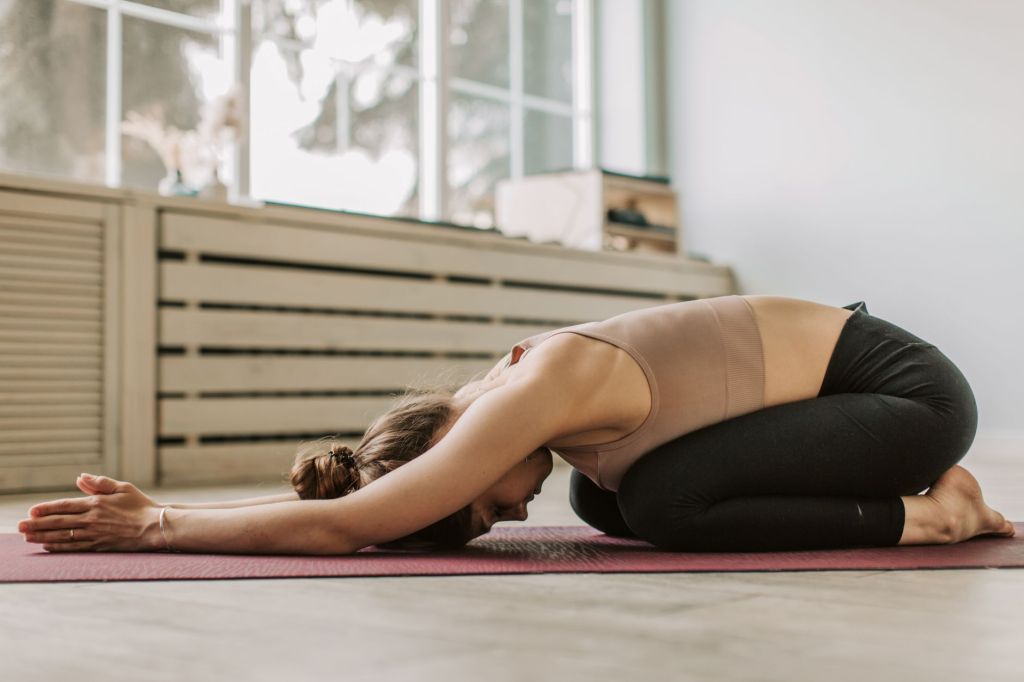
I leave my bed in the morning begrudgingly, not ready to meet the continuous demands of the day ahead. My baby is already making himself heard from his crib, demanding attention. Yet I pause for perhaps thirty seconds, placing my body into extended child’s pose on the floor. I have chosen this posture because it is an embodiment of surrender, much like a full prostration. Yet the knees are bent and spread, arms outstretched so within the bowing it creates a type of cave for my heart. This posture becomes a prayer without words, a plea to manage surrender to what I cannot control and do not want to face. Yet also a position of self-compassion and tender care to my heart that genuinely possesses needs as well. It is both a validation and a setting aside of self all in one. It is a holding of seeming contradiction. It is a searching for abundance in the midst of scarcity. It is an offering of trust—that if I bow, I will also be held.
In my growing up years my body was simply a tool to use to accomplish things and largely to ignore if it got in the way.
This was never explicitly stated to me, but looking back it’s perhaps how I would encapsulate what was modeled. The body was not an integrated part of my religion. If anything it was something to fear or be cautious of, especially as a female. Allowing the body to suffer in discomfort or pain or exhaustion in the name of service to others or sacrifice somewhere such as a mission field seemed to be lauded. The year I spent in the cult, I was allowed little to no rest. My body (and my emotions) were something to be overcome, not something to be listened to and learned from.
I was in my mid-twenties before I started to actually tune into my body at all and notice how much muscle tension I was carrying. The therapy practice of EMDR taught me to attune on a deeper level. Where did I feel distress in my body? Where did it carry memories and pain besides just in my cognition? I also began practicing yoga and breathwork, finding what I did with my body could have an intentional calming effect on my internal wellbeing.
This year my theme seems to be embodiment. I’ve done less spiritual reading and more focus with my limited time on embodied practices. In the past handful of months, I repeated an online course with an online cohort of friends. We had all taken this course before, but never together. It was a redone course, so the videos and content were similar but also new. The first time I engaged with the course, it was a fire hydrant of information. There were embodiment practices included, but I often didn’t get to them in my mad rush to listen, take notes, and comprehend the material. This second time the material was a bit like an old friend. I didn’t take a single note. Rather I focused my energy on the embodiment exercises and found they were teaching me something the intellectual center could not.
The body carries a language and wisdom all its own.
This isn’t something I can prove or offer much in the way of rational explanations. It’s probably something that must be experienced. But it begins with an openness to believing this might be true. Otherwise, why would you bother listening to the body at all?
All I can offer are snippets of my experience, and because they are embodied moments, words ultimately fail them. Yet for your sake I will make an attempt.
Accepting my body on the mat in yoga taught me to accept myself in all its messiness off the mat. When Adrienne’s voice came through her YouTube channel and admonished that today my body might feel different than yesterday and that is okay. It’s all good. All welcome, my body wisdom told me this didn’t just apply to the yoga session. The invitation was not to react to my body with frustration. The invitation was also to react with kindness to myself in its messiness off the mat. It was really a lesson in self-compassion and acceptance.
EMDR is a trauma processing method in therapy that typically begins with identifying a traumatic memory and then sensing it the body. However, some of my deepest and most intense sessions (and therefore most effective) came for me when I began with a global sense of emotion that I carried in my body. I didn’t know where it would lead, but I leaned into sensing that emotion and holding it in my body. Then my body seemed to take over and lead me where I needed to go.
My most intense moment of channeling Divine love came in a moment when my body unleashed a wave of grief. I listened to the signals my body sent and took the grief into an embodied practice, moving into the motions of a Sufi turning prayer while letting the resonance of a chant travel through my core. I hold close what happened next with tender, sacred awe. I sensed the Divine in a way I never had before.
My recent course offered the invitation to regularly sense my feet. Like breathwork, it’s another way to slow down, pause, and invite presence throughout the day. You could try it now. Where are your feet? Can you really feel them? Just bring your attention to wherever they are and observe. My first attempts felt clumsy and awkward. But now, if I approach it unhurried, sensing my feet often opens up a current of energy in my body. It shifts something within me, an alignment with what I believe is always there but I’m often too harried to notice. Pairing this practice with centering prayer has also offered surprising results. When my sacred word activates my intellectual center too much and sends my thoughts racing, choosing to sense my feet instead seems to restore my focus and openness in a more effective way.
My wisdom course also offered an atmosphere sensing exercise, which was mostly a type of body scan or yoga Nidra, with the added dimension of sensing an added sphere of energy around you. I imagine myself in the safety of a womb. Regardless of the chaos around me or within me, if I can slow my body down and take time to sense it, then I can be reminded that I am safe and cherished and protected within my atmosphere. The body senses a truth the mind cannot rationalize its way into.
Body vs. Spirit – A False Dichotomy
I recently had a spiritual conversation with a mom at my daughter’s school who considers herself spiritually unattached. She came right out and asked me bluntly, “Now what are you spiritually? You go to church but you mentioned something about sensing body energy. I didn’t think Christians did that.”
I laughed, acknowledging her befuddlement.
“Yes, I consider myself a spiritual mutt,” I said, and that wasn’t even considering the menorah sitting on my library shelf.
We had a meaningful conversation, but I was grieved at her impression of how closed Christianity seemed to the integration of what she saw as the natural energy of the body and what I might call the flow of the Divine or simply put—the Spirit.
This closed posture is perhaps beginning to dissolve in places, but this faulty thinking stems from the body being pitted against the spiritual, a habit that goes back centuries. The word translated “flesh” in modern Bible translations is often equated with the body. So when Paul states, “For the desires of the flesh are against the desires of the Spirit” (Galatians 5:17) then no wonder the average reader and theologian interpret the body as some kind of enemy to be resisted and put in its place. Yet, the meaning of this passage and others would drastically change if one considers the meaning of “flesh” to mean the false self, the self out of alignment with the true self which was created in the image of Divinity. Flesh = false self = egoic consciousness = negative coping mechanisms = misaligned constructs from which we view and interpret and choose to act in the world.
Consider if verses such as Galatians 5:17 were translated the following way instead: “For the desires of the false self (or ego) are against the connection to the energy of the Divine (or higher consciousness), and the desires of higher consciousness are against the false self, for these are opposed to each other, to keep you from doing the things you want to do.” This conflict does not lie between the body and the internal or spiritual reality. The conflict lies between one part of the internal world with another part of the internal world. And when it comes to realignment with a higher awareness of consciousness of God, the body knows the way better than your mind does.
She who has cells within her being to perceive, let her perceive.
He who has cells within his being to perceive, let him perceive.
Resources
- For more ideas and resources on embodiment practices see my webpage: Embodiment
You are most welcome in this space. If you would like to have my writing delivered directly to your inbox you can subscribe below or find me on Substack @danielleklafter. If you have thoughts, feedback, or questions, you can contact me via the contact form on my website. I welcome dialogue.
Shalom.


