
This is the second post in a three-part series. Part 1 can be found here.
You can listen to this post read aloud by the author or you can read it for yourself below.
I brought another human into the world eight months ago. Hence my months of radio silence on the writing front of late, returning in fits and starts. (In the chaos of motherhood, I work each day to allow what I can get done to be enough, and I attempt to forgive myself for the unwarranted shame of what I want to accomplish and don’t. Perhaps you will join in offering that graciousness to me as well—and to yourself for whatever reason you need, dear fellow beloved human being.) A season of caring for an infant, and really the whole first year or more of nursing, means things I love get sacrificed. Even things I need must get set aside for a season. I have less space for quiet, reading and reflection. Less time to write (this blog series is being written over multiple nap times often broken up by weeks before it comes to fruition). And certainly less time to engage in contemplative spiritual practices like monastery retreats or even daily centering prayer practices which require twenty minutes or more of uninterrupted silence.
So how do I merge the invitation to follow the four quadrants of ora et labora (or any spiritual practice) with the current realities of my life? I have often felt my duties as a mother in direct contradiction with the desires and practices of a spiritually attuned life. Gone are the long moments of silence, the ability to set a schedule and keep it without interruption, lingering over a book or a thought, being able to encapsulate it in my journal before it escapes.
On a recent Sunday afternoon I rolled out my yoga mat on the front porch while the baby was sleeping. I explicitly explained to my nearly-five- and seven-year-olds that I had just spent the entire previous day throwing one of them a birthday party, and I was going to take twenty minutes for myself to do yoga. I would be unavailable for twenty minutes. Yet my children followed me outside to ride their bikes up and down the block. (There’s something about them just wanting to be near me.) I resented the intrusion of the noise but worked to let it go. Despite my requests (and their ability to play independently for that amount of time), I was interrupted four times throughout my practice. Mom, can I ride down to the busy street and back? Mom, can you buckle my helmet? Mom, did you see me ride fast?
My internal world grew spicy.
I raised my voice a bit. I had a set a boundary and they didn’t honor it. Yet, there was also an opportunity for self-observation. There’s nothing wrong with trying to set a boundary for self-care by any means. Anger is often a red flag that boundaries are being violated. My children need to learn to respect my boundaries. However, when the flow of life presents things out of my control (like how many times my children interrupt me), what can I learn from this moment of friction? Can I only do yoga and center myself in ideal circumstances, or can I learn to do it regardless of what is going on around me? Do the interruptions of my children become the friction that pushes my practice deeper, enhances my skill at staying grounded amid chaos?
While I was enjoying my last retreat at my favorite local monastery exactly a year ago, I read Ronald Rohlheiser’s book Domestic Monastery. It’s a small little thing. I finished it in forty-five minutes. But I’ve been leaning into the ideas for the past twelve months.
He writes, “[Raising children] provides a desert for reflection, a real monastery. The mother who stays home with small children experiences a very real withdrawal from the world. Her existence is certainly monastic. Her tasks and preoccupations remove her from the centers of social life and from the centers of important power. She feels removed. Moreover, her constant contact with young children, the mildest of the mild, gives her a privileged opportunity to be in harmony with the mild and learn empathy and unselfishness. Perhaps more so even than the monk or minister of the gospel, she is forced, almost against her will, to mature. For years, while she is raising small children, her life is not her own, her own needs have to be put in second place, and every time she turns around some hand is reaching out demanding something” (13).
It seems I have a choice.
Either I can be frustrated that parenting inhibits my desire to do other things that I consider “more spiritual,” or I can accept the current limitations of my life and trust that those very limitations are the means of my spiritual transformation in this season.
Rohlheiser defines, “What is a monastery? A monastery is not so much a place set apart for monks and nuns as it is a place set apart, period. It is also a place to learn the value of powerlessness and a place to learn that time is not ours, but God’s. Just like a monastery, our home and our duties can teach us those things” (18).
Maybe you are reading this and you aren’t a parent. That isn’t the point. Forgive me if all my examples of parenting don’t seem applicable to you; they just happen to be the current format of my life. Look at your life and ask yourself, what is the current scaffolding of my existence? Whatever that scaffolding is, that is the very means of transformation available to you in this season. There are plenty of things in this world which we naturally want to resist, things that are hard. Things we’d rather change. It might be your job, or bills that need paid, extra sacrifices of your time and energy in order to pay them. It might be a change from corporate outside of your control which has a drastic impact on your day-to-day life (like my husband recently experienced). It might be a schedule you have to keep, schooling you need to finish. It might be caring for an aging parent, or living with an illness or physical limitation. It might just be the news cycle or aspects of your family history that you inherited when you were born into this world. It might be too many hours alone. Whatever your scaffolding happens to be, it is perfectly tailored as your opportunity for transformation.
My Four Quadrants
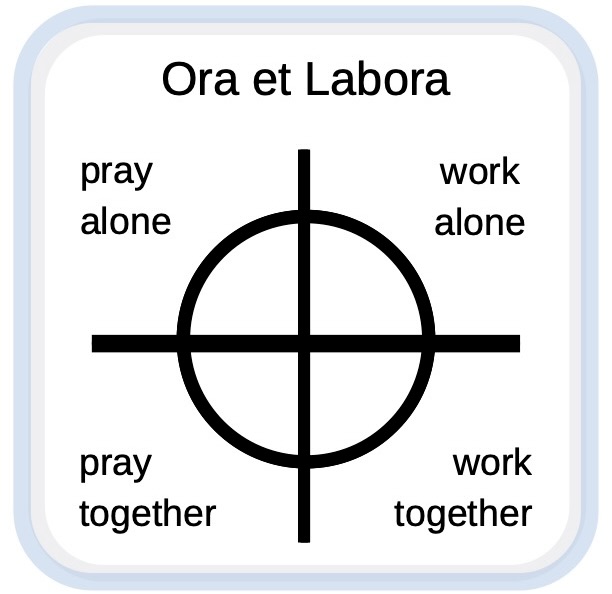
The point is to take the scaffolding and lean into the aspects of the four quadrants that are already there, making small tweaks to include some of the others where possible. It’s an imperfect attempt. As a friend pointed out, my life these days is perhaps too heavily tilted towards work together. These are my daily tasks of diapers and laundry, dishes and school lunches, feeding my children—yet again. Can I bring more intention to these moments? Can I sense my feet as I work? Can I choose to be fully present and welcome and surrender to the task rather than performing it resentfully? Can my body teach me a wisdom only it knows as I work?
My work alone right now is my writing. It’s my specialized skill I can bring to bear. It’s a leaner season for words, but I’m working them in where I can, and surrendering to the days when my rhythm doesn’t allow for finding them.
My prayer alone is also hard to find in abundance. Yet expanding the idea of what “prayer” looks like can help (see my previous blog post linked below). Yoga can be prayer. So can taking a walk with my son on my back. So can weeding in the garden if I bring my attention to the task in a meaningful way. This quadrant can also include study or sacred texts such as the practice of Lectio Divina. Sometimes I flex to include meaningful podcasts or audiobooks in snippets of drives on my way to pick up kids from school. It’s not my preferred method, but it can count. That’s the point of the monastic tradition. The intention and presence brought to the task matters more than the task itself.
Prayer together is reaching for community. It might be a religious service, but it’s also space shared with a friend on my porch, a zoom call with my wisdom cohort, opening my home to a weekly small group. It’s any way I hold space to recognize my connection to the broader whole, fostering a unitive consciousness.
Lean In
Cynthia Bourgeault encourages this leaning into what is already in front of you in the Wisdom Waypoints Introductory Wisdom School course. She challenges anyone to “start by looking at the conditions of your own life and not willy-nilly fighting against them. The conditions are precisely the conditions in which you are going to transform. You don’t have to remove large-scale the conditions in order to be spiritual. The first step is really learning how to use what can’t be moved in your life as a grid for growth. Worry about the question of what has to be changed later.”
Some days I hate this. I would rather have more control over choosing what happens within the day-to-day hours of my life. Some future distance in time I will perhaps regain more of that. But for now, my job is to do the best I can for myself and surrender into the rest of it, trusting that Divine abundance will catch me, hold me, show me a way through. If I merely see this time as a phase to endure, not only will I miss some of the joys of being fully present as my children grow, but I will avoid the transformation that is offered to me as a gift, a form of abundance that does not feel comfortable at all. True transformation and deepening levels of consciousness does not happen in ideal circumstances. It happens in the places that are dark and grief-laden, full of pain, or at least an overabundance of the mundane.
She who has eyes, let her see.
Related Posts:
- Part 1 of this blog series: Domestic Monastery: The Framework of Ora Et Labora
- Part 3 of this blog series: Domestic Monastery Part 3: My Own Monastery Bell
- A previous post on expanding the definition of prayer: Prayer as a Way of Being in the World
- A recent post: Abundance ≠ Comfort
Other Resources:
- Domestic Monastery by Ronald Rohlheiser
- Introductory Wisdom School course at Wisdom Waypoints
- Wisdom Distilled from the Daily: Living the Rule of St. Benedict Today by Joan Chittister (I have yet to read this one but it’s in my cue of books!)
- The Cloister Walk by Kathleen Norris (a memoir about a lay person’s experience in a monastery)
You are most welcome in this space. If you would like to have my writing delivered directly to your inbox you can subscribe below or find me on Substack @danielleklafter. If you have thoughts, feedback, or questions, you can contact me via the contact form on my website. I welcome dialogue.
Shalom.


2 responses to “Domestic Monastery Part 2: Tailoring the Framework to What Your Life Already Is”
[…] Part 2 of this series can be found here: Domestic Monastery Part 2: Tailoring the Framework to What Your Life Already Is […]
[…] This is the third in a series of posts. You can find the first two here: Domestic Monastery Part 1: The Framework of Ora Et Labora and Domestic Monastery Part 2: Tailoring the Framework to What Your Life Already Is […]