You may listen to this post read aloud by the author or you may read it for yourself below:
It’s an ongoing point of amusement in our home regarding how I prefer to spend a free, untethered weekend [a rare occurrence] to do anything I choose. My husband, on his trips away from home has chosen excursions such as a concert at The Sphere in Las Vegas, final four basketball games, or a board game convention. They tend to be loud, active, stimulating weekends.
When it’s my turn, he likes to tell his coworkers, “My wife has an exciting weekend away planned.”
Pause for dramatic effect.
“She’s going to a monastery.”
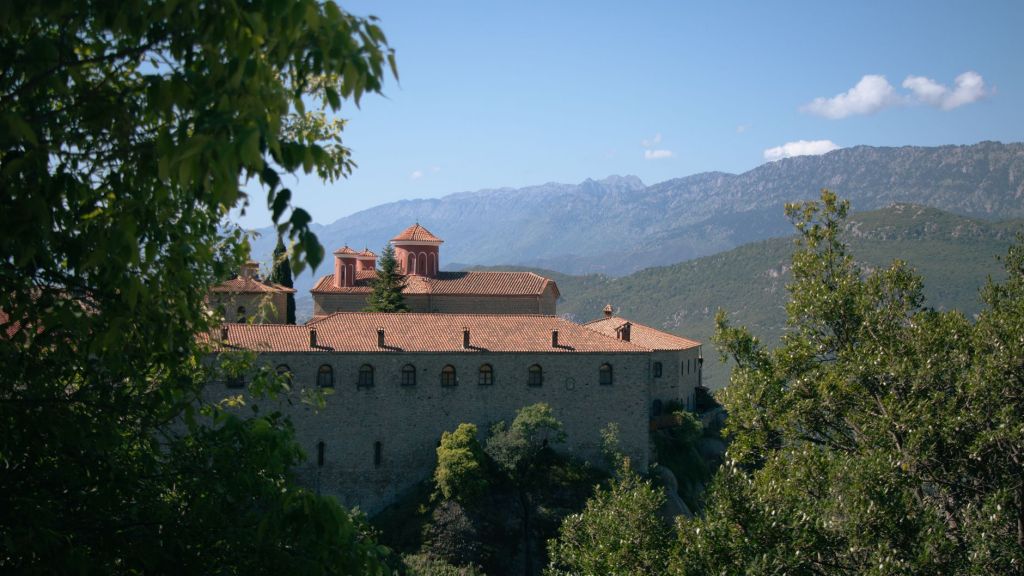
It’s true. My favorite place to get away (besides being ensconced without cell service on a backpacking trip in the mountains) is a rural Nebraska retreat center attached to a Benedictine monastery. I’ll go spend hours or days in quiet, walking the grounds and reading and writing until I can’t bear to do it any longer. The quiet feeds my soul. The last time I was there I got to stay for almost five days, and I made the walk up the hill to the actual monastery a handful of times to join the monks in their daily offices.
I heard the bells echoing through the monastery, the air of each room resonant with the sound as if it might expand and take up all available space. It filled my lungs, the cells of my being, and pressed beyond mere concrete blocks to invite the very cosmos to answer their call. Within a few minutes the monks trickled in, silently taking their places in the chapel pews and we began the liturgy of both chanting and speaking prayers, psalms, and sacred texts. When the liturgy was complete, I paused on my walk back to the retreat center to watch the sun set over the cornfields, the breeze rippling the rows to mimic rising swells of a verdant ocean. My soul felt grounded and open, soaking in the beauty of the moment.
I love these moments of oasis in my life, but they are moments, not the norm. I’m married. I have three children. I will not be abandoning these relationships and joining a monastery to sequester myself away from the world in permanence. The Divine journey would never invite me to cause such attachment trauma (nor do I have any desire to abandon them, in case that’s any concern of yours). In general, the longevity of these sequestered monasteries is dwindling. There are fewer people who want to commit themselves to such a lifestyle full-time. Yet, there is an increasing desire to make the rhythms of such communities more accessible to the rest of us who are working jobs and raising families and doing the common labor of life. Some of this attention was instigated by Kathleen Norris’s book The Cloister Walk. The real question is, what is the framework or principles behind the monastic life? What purpose does it serve? And are those principles transferable to another way of life?
I’ve been wrestling with these thoughts for the past calendar year, both from reading a small book entitled Domestic Monastery by Ronald Rohleiser and from re-taking an Introductory Wisdom School course with Cynthia Bourgeault. This blog post has been in progress in my head and somewhat on paper for over eight months, but it has felt unwieldy. Therefore, I’ve decided to break it up into parts. I’ll begin here by explaining the overall design structure of such a monastic life. Part two will involve possibilities of adapting that structure to daily living. Finally, part three will entail my vulnerability for how I’ve been wrestling through accepting that structure in my own life.
Ora et Labora
The Benedictine monastic tradition practices what they call ora et labora, which is simply Latin for prayer (ora) and work (labora). Days in a monastery are divided up into rhythms of both prayer and work. Seven times a day monks answer the call to more formal prayer and liturgy, breaking up their physical tasks of labor into reminders to reground and recenter with the Divine. However, there is not meant to be a distinction between prayer and work as one being sacred and the other mundane. Rather, the intention is to blend the two entirely, working to release the false self with its egoic constructs so completely it doesn’t matter what one is doing externally. Whether chopping carrots in the kitchen, meditating, or singing cantos in the choir, the identity of oneself can remain the same. So can one’s connection to the Divine.
Cynthia Bourgeault identifies another distinction in the Benedictine rule of life and creates four quadrants from their daily rhythms:
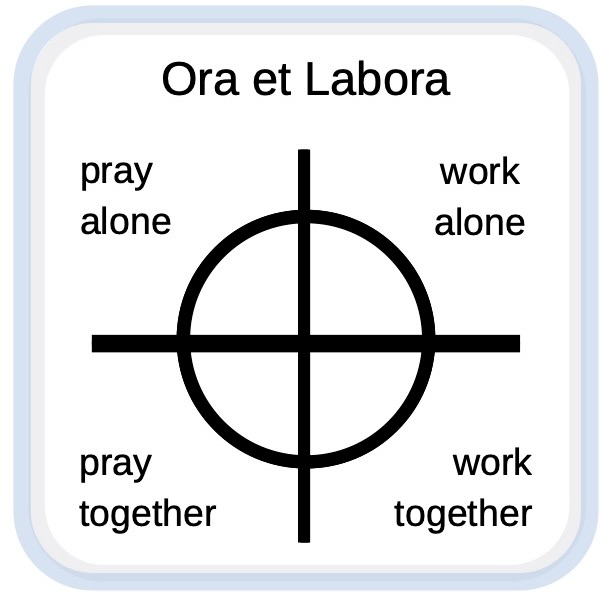
These four quadrants bring balance not only to the centers of the body, mind, and emotion with various of tasks, but also between the spectrum of living as a hermit and living in community. We need both. We need the quietude of time alone for reflection and we also need the friction of community to illuminate our inner faults and egoic tendencies. Also to offer ourselves in service to the collective whole. So ultimately the point of the Benedictine model is transformation.
Within the model, no one person is allowed to settle into the same role consistently. Everyone gets to take a turn chopping carrots in the kitchen. Even if you are clumsy and unskilled. The most efficient carrot chopper isn’t allowed to stay in the kitchen indefinitely. We are often comfortable in the places where we are skilled. We also develop attachments to those aspects of our lives. We develop our egoic identity around these identifiers. I am a writer. I am a mother. I am a gardener.
It’s not wrong to be skilled at something, but to develop an attachment to such a skill so it becomes an identity only fuels the false self. It is such a paradoxical balance to hold. I am a writer. There is no doubt that the Divine One designed me to shape words and share my vulnerability. When I manage to put words onto a page, I settle into a deeper sense of contentment. I pray that my offerings serve others as well. It’s not that I should deny any of that. But if I cling to that role of writing as an identity, then it will hamper my transformation to higher consciousness. What would happen to my sense of self if I were suddenly stripped of the ability to write? Or like this year, when I am severely constrained by the demands of motherhood so it rarely happens? Am I still the same person at my core?
The Benedictine model offers the opportunity to learn that my core identity and my connection to the Divine can remain the same no matter what I am doing. For the monk that might mean moving from mucking out a pig stall to chanting the Psalms with the same sense of grounding and presence. For me it might mean moving from this blog post to changing a diaper and cleaning up the kitchen.
The Four Quadrants
In the life of a Benedictine monk, here is what the four quadrants largely entail.
- Prayer alone: Lectio Divina (a sacred reading and study of scripture)
- Prayer together: the choir, chanting the psalms and liturgies together in the daily offices
- Work alone: craftsmanship, scholarship, artisans (here was the room for specialized skills to be brought to bear)
- Work together: collective work, mostly manual labor required for survival such as cultivating the land
I’ll spend the next installment of this blog series exploring deeper what it might mean to adapt this structure into modern daily living on a practical level. For now, it’s just helpful to note that all four of those quadrants were a part of the model and all four of them were considered sacred in the sense all four contributed to the inner transformation of the spiritual journey. If you are anything like me, you might have a tendency to feel some of them are more “spiritual” than others. Maybe that is just because they feel better, or the applications to spiritual transformation seem more obvious. But the deeper I press into the wisdom path, the more I am leaning into the reality that the mundane collective work—the embodied work—often has the most to teach me in my transformation journey. It’s the place where I most encounter friction, where my egoic tendencies flare up the strongest. It offers so many places to lean into the practice of surrender, the welcoming of what is.
She who has ears, let her hear.
Resources:
Part 2 of this series can be found here: Domestic Monastery Part 2: Tailoring the Framework to What Your Life Already Is
- The Cloister Walk by Kathleen Norris (a memoir about a lay person’s experience in a monastery)
- Domestic Monastery by Ronald Rohlheiser
- Introductory Wisdom School course at Wisdom Waypoints
- Wisdom Distilled from the Daily: Living the Rule of St. Benedict Today by Joan Chittister (I have yet to read this one but it’s in my cue of books!)
You are most welcome in this space. If you would like to have my writing delivered directly to your inbox you can subscribe below or find me on Substack @danielleklafter. If you have thoughts, feedback, or questions, you can contact me via the contact form on my website. I welcome dialogue.
Shalom.

 Danielle Klafter
2 responses to “Domestic Monastery Part 1: The Framework of Ora Et Labora”
[…] This is the second post in a three-part series. Part 1 can be found here. […]
[…] is the third in a series of posts. You can find the first two here: Domestic Monastery Part 1: The Framework of Ora Et Labora and Domestic Monastery Part 2: Tailoring the Framework to What Your Life […]