You can listen to this post read aloud by the author or you can read it for yourself below:
My baby sleeps.
I am bringing the full force of a newly purchased splitting axe into the roots of a Japanese barberry. As I pry the branches of the bush away, thorns prick my fingers through heavy work gloves. I want this bush gone to a place where it can no longer harm me, harm my children, harm those who visit the piece of earth we call home.
When the vegetation is removed, I hack at the roots with fury, wielding the axe over and over, relishing the aggressive energy it channels through my body. I am angry—at so many things these days—beginning with the greedy private shareholder group that has suddenly transformed my husband’s job into something that has left us all reeling. Normal is gone and de-stability remains. Sharp garish spikes of the barbary roots remain embedded in the ground, like a city of invasive spires. Yellow wood chips fly, my determination rising. I’ve never seen yellow roots before, their bright forms a stark contrast to the dark soil around them.
In the midst of destabilization and long fourteen hour days of juggling needs of children on my own, I want to be able to surrender to the flow of life, to what I can’t control. Resisting what I hate does me no benefit—it merely saps my much-needed energy and leaves me feeling miserable. I know what the wisdom path invites—a welcoming and letting go. I can see the way this job change activates my ego, lays bare all the comforts I have grown accustomed to, threatens my sense of boundaries. The very words “I hate this” are a form of self-identification. I am identifying with my feeling of hatred, placing myself as a victim to my circumstances, to a corporate board I have never met. I can watch all this in my response like an old VHS tape slowly unwinding, then respooling to play over again until the quality wears down to threadbare static. I know this dance.
I cannot change the decisions an investment group made, or the reality of my husband’s current schedule until enough time passes for us to fully reassess, enabling us to choose our path again. I cannot change the ever-shifting needs of my children or hand my baby to be nursed by someone else. These constrains are the current scaffolding of my life.
At the end of a recent string of short morning naps, I strap my cranky baby to my back and head out on a walk. I am listening to a teaching by Cynthia Bourgealt as I pace the neighborhood and her words transmute through my earbuds. She issues an invitation to “freedom of imagination to start by looking at the conditions of your own life and not willy-nilly fighting against them. The conditions are precisely the conditions in which you are going to transform. You don’t have to remove large-scale the conditions in order to be spiritual. The first step is really learning how to use what can’t be moved in your life as a grid for growth. Worry about the question of what has to be changed later.”
These conditions are precisely the conditions in which I am going to transform. I feel met, as she were speaking directly to me. Also chastened. Part of me wants to groan and leave my earbuds on somebody’s front lawn. I know she is right. These circumstances are my scaffolding for transformation. I don’t like them, but I suspect no one in transformation ever does.
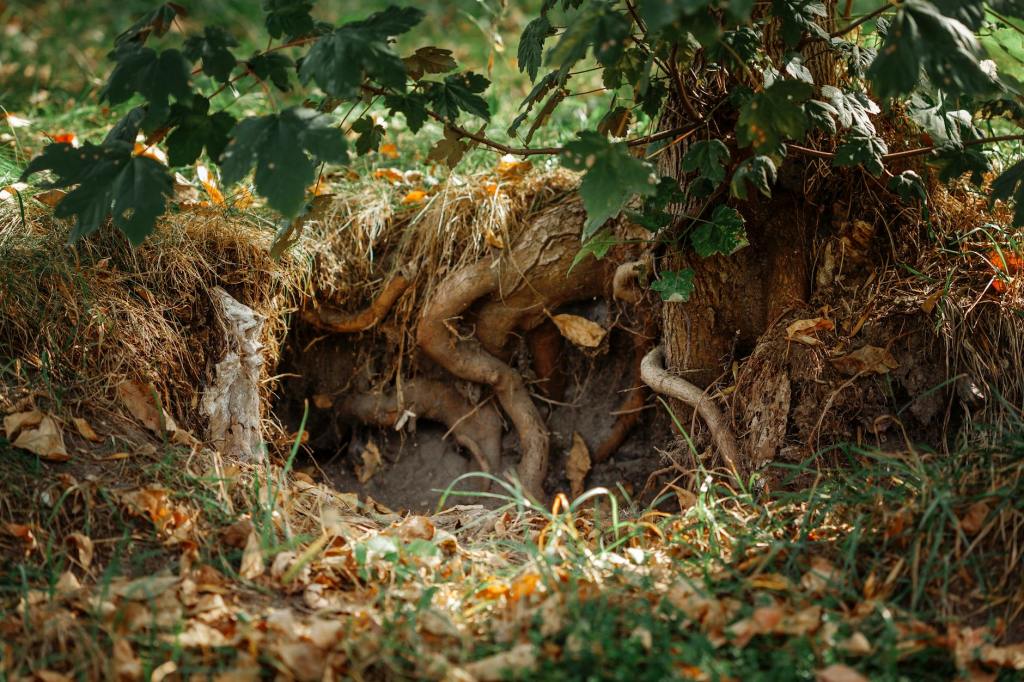
Yet despite my desire to sink in and let go, I cannot. Or at least the process feels so painstakingly slow I doubt I will manage it before my children are grown. It is like the bright yellow roots I am hacking. I am stuck in this world of resistance even when the thorny branches are gone. I chip away at the mass of roots that remain, splinters flying. But as deep as I work, I cannot eradicate the whole root. It goes deeper than I know.
My legs break out in spots from kneeling in the grass. My shoulder aches from the effort. The spot between my thumb and index finger remains bruised for days after.
My baby wakes—much sooner than I think he should. I sigh. Everything feels hard. But I take off my gloves, go inside, change a diaper, nurse a baby, and then resettle him outside on a blanket in the yard before I get back to work, knowing I will only get perhaps fifteen minutes before I must attend to him again.
Removing these roots reminds me of my time in the cult. My cult leader had an analogy about weeding. According to her, weeds were like sin. You had to pull them up by the entire root or they would regrow back, the next time stronger. This may have simply been justification for what she called “weeding encounters.” As if hours of weeding her property during chore time could be transformed into a spiritual practice. At the time I swallowed the experience whole. But now I can’t help but think this analogy is a false one. It is an analogy that belongs to forms of religion that promise quick easy answers and black and white solutions. Pray the precise words to renounce some long-rooted generational pattern. Label it a demon with the correct name so you can cast it out and be done for good. Go to the right conference and it will solve a problem. End of story.
But is this approach a form of true grace? Or it is a way for me to reinvent my ego with religious overgarments?
I want the roots of this bush to disappear. I wish I could take them wholly out, but all I can do is hack at them layer after layer, each time letting the cut go more deeply into my false self. If I could take them out entirely then the work would be done. What need would I have of being met by the Divine? What need would I have to keep journeying? The relentlessness of the journey is a mercy of sorts.
Richard Rohr writes, “People only come to deeper consciousness by intentional struggles with contradictions, conflicts, inconsistences, inner confusion, and what the biblical tradition calls ‘sin’ or moral failure. […] In other words the goal is actually not perfect avoidance of all sin, which is not possible anyways, but the struggle itself, and the encounter and wisdom that comes from it” (Breathing Under Water p.31). He also states, “The more you are attached to any persona (‘stage mask’ in Greek) whatsoever, bad or good, any chosen and preferred self-image, the more shadow self you will have. So we absolutely need conflicts, relationship difficulties, moral failures, defeats to our grandiosity, even seeming enemies, or we will have no way to ever spot or track our shadow self” (p.33-34).
“It’s a gift you see,” my spiritual director has told me. Sometimes all I can see is my ego in operation, my reactions in progress without feeling there is a way to stop them. This feels so frustrating. But she reminds me the seeing is a gift. So many people cannot.
So I accept my physical limitations of what I can and can’t do with an axe and have to let what I’ve removed of the yellow roots be good enough. Maybe I am not meant to be able to eradicate the whole root. Sometimes that’s possible. But the deep wounds are harder to kill. We live with them. Perhaps mostly made useless after a lot of work. They don’t show themselves as often on the surface of our lives. We can plant other things overtop them like I do with the ring of Hosta transplants now encircling my tree a week later. But the remnant roots remain beneath the soil. You might not know they are there, but I do. They are part of the ground where I live. I can accept them, work around them, seek to give them boundaries, but my false self is embedded so deep the journey goes on. It always will. Some days there is an exhaustion or frustration with that. Some days there is also a mercy.
You are most welcome in this space. If you would like to have my writing delivered directly to your inbox you can subscribe below or find me on Substack @danielleklafter. If you have thoughts, feedback, or questions, you can contact me via the contact form on my website. I welcome dialogue.
Shalom.


One response to “Roots”
[…] one hurried blog post months ago. One afternoon while I am hacking at thorn bush roots with an axe (see my last post), my thoughts are brimming with words but there is no way to get to a computer to write them down. […]