
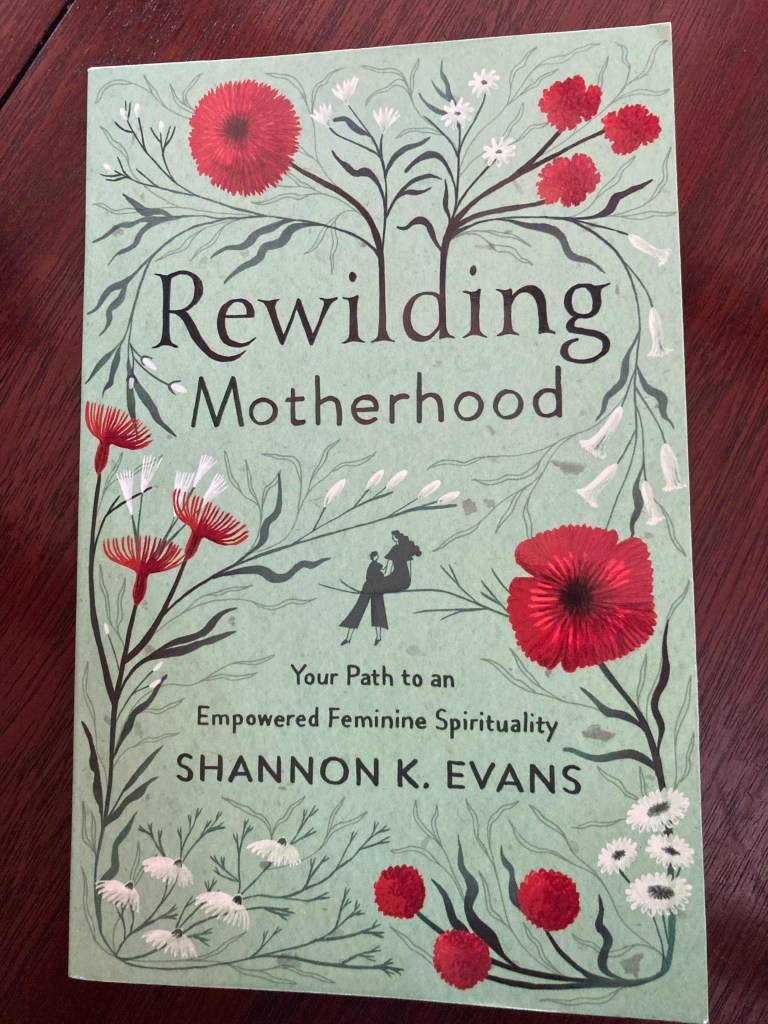
Last week I finished reading Rewilding Motherhood: Your Path to an Empowered Feminine Spirituality by Shannon K. Evans. It is hands-down my favorite book I’ve encountered on motherhood thus far. Part of that reason is that it’s not really a book directly about motherhood.
It’s not a how-to on raising children. There’s zero shaming about what I should be doing differently or opinions about what style of parenting is most effective. It’s mostly a nuanced book about spirituality within the context of being a female and being a mom (which she also takes space to acknowledge can look like a whole lot of different things.)
[Dudes, this post more heavily tilts towards women, but consider reading it and buying a copy of the book for the mother of your children, or the mother of your grandchildren. Or even read parts of it for yourself, to help stretch your masculine mindset when it comes to your partner whose body, soul, and spirit carries motherhood and the Divine in a way you never can. Dive in. Don’t be shy.]
I didn’t know Shannon K. Evans before picking up this book. I saw the title in a picture of someone’s reading pile on Substack or Threads and bought it on a whim. One of my best impulse book buys. She’s a mom of five and lives somewhere in the middle of Iowa, and she has a fascination with female Christian mystics. Upon finishing her book, I immediately pre-ordered her forthcoming title The Mystics Would Like a Word: Six Women Who Met God and Found a Spirituality for Today. Under other circumstances, I’m sure this woman and I could sit down and become fast friends in less than an hour.
Within the pages of Rewilding Motherhood, I felt my deep longings were seen and voiced by Evans. Also, the limitations of this season of life and our place in the world as women. It was a book that didn’t ask me to do or accomplish anything else in my already full plate. But it did invite me to pause and shift and look at what is already there from a different perspective. And then take courage to own myself, my longings, my aspirations, and my motherhood. Her words were validating, inspiring, challenging, and empowering.
One of the first things she does is tear down this myth of perfection that we all feel we are under or tend to put ourselves under as mothers. After describing a piece of art depicting the Mother Mary and child, both fallen asleep in utter exhaustion mid-nursing, she writes, “Unable to live up to her own myth. This is the myth of the ever-accessible mother: the mother who will always give tirelessly, smile tenderly, respond patiently, and accept the hand she has been dealt with endless grace and ease. It’s a fiction, a caricature of a mother. It is not reality. Real mothers wrestle. Real mothers fail. Real mothers lose it, pick themselves back up, dust off their ego, hug their child, and try it again. Real mothers must learn to have patience with themselves just as they are trying to learn patience with their children” (74).
My eldest started her first day of school today. I just watched her march into the building all by herself, lugging her lunch box like a brave little champ. I’m proud and excited and a bit emotional that we’re at this stage. We’ve enrolled her in a private school that approaches education differently, so my husband and I spent most of Saturday at a parent bootcamp in preparation, followed by a launch party at the school with all the children in tow. It was a good day, but extremely overstimulating and exhausting for me. Sunday I was fried and frazzled. I was irritated by small requests from my children that weren’t really that unreasonable. I had spent all my energy Saturday in what was an act of commitment and love and sacrifice for my child. But of course she can’t see it that way at this stage. All she knew is that she didn’t get much time with me on Saturday and then Sunday she wanted so many things. The fifth time she impatiently asked for strawberries which she wanted on her waffle, I clenched my fists and said her name and uttered the words, “If you don’t stop saying that I’m going to strangle you!” Not my best moment. I soon left the house for a couple hours so I wouldn’t do something I would regret. But that was an intentional self-care decision and a win.
Later that evening when we were both calmer, I had a bit of a conversation with her about it. She was telling me she wasn’t going to get any strikes at school (a system they use for increasing consequences if there are a pattern of boundary violations of the code of honor). Bless her soul. She means well. She wants to be perfect. But that’s not what she needs. And it’s not what I need either. “Sometimes we all have hard days,” I said. “Even me. Remember when I was grumpy and tired this morning…” I’m not always consistent, but sometimes I catch moments of opportunity to connect her emotional dysregulation to mine. See, we all need do-overs some days. We all fall and have to get up and go at it again.
Evans points out this need as well: “Even aside from social pressures, we sincerely want to be the mothers we believe our kids deserve. The thing is, sometimes that keeps us from being the mothers our kids need—which, I would argue, are mothers who demonstrate what it is to struggle, fail, recenter, and refocus. Our children are not going to grow up to be perfect themselves, so do they need an unrealistic model of flawlessness—or do they need someone to show them what it means to navigate their flaws with empathy and connection?” (76).
Evans surprised me several times in this book. There were several chapter titles where I thought, Oh I know what she’s going to say in this one. Nope. Never mind. My expectations were subverted in marvelous ways. I won’t share them all. You should go get your own copy and enjoy the read for yourself. But one of those chapters was entitled “Cultivating Patience: Holy Resistance in an Age of Rush.” I assumed it would be something related to getting off my phone and slowing down, a notion I’m always for, but also a notion that is often unrealistic in the motherhood stage. I never get as much unhurried quiet as I long for. But no. Evans instead makes it about making peace with how our aspirations get thwarted and delayed in motherhood. Nothing goes as fast as we’d like it to because we have to get up and change diapers, break up sibling fights, change a load of laundry, you name it. She invites patience with this reality—accepting limitations. But also not accepting that the limitations mean we can’t do the thing our soul longs to do at all. Make it happen, she encourages. Just do it slowly.
“As mothers, we are tasked with following our ambitions and creative expressions in a more roundabout way than fathers or childless women have to do. For us there will never be enough time to devote to the art we want to make, the words we want to write, the business we want to start, or the activism we want to pursue. It will never make perfect sense. It will never be approved of by everyone we know. It will never feel like the best use of time.
Do it anyways.
Do it half speed when you wish you could give it your all in one fell swoop. Do it bit by bit, knowing that in other circumstances you would have wrapped it up by now. Do it slow and steady, nice and easy, and shrug it off when people act like it’s a cute hobby you have or a side gig. Let their attempts at diminishment slide off like water from a duck’s back, because you don’t have time for that mess. You are building and creating and dreaming, and you’ve got school pick-up at 3:30” (81).
I think of my writing a lot here. I have manuscripts I want to finish, goals I want to meet. I want to go after them. I quit my paid job so I could make a job of this. And yet, I can take concepts like Cal Newport’s Deep Work that claim high levels of creative work require large chunks of time dedicated to being logged off the internet and unplugged from other interactions and end up feeling very frustrated. It all sounds good. I’m for it in concept, but it only works for an individual that is allowed to turn their phone off and time away from any other obligations. I couldn’t help but wonder if Newport’s work style works for him because he has a wife at home juggling all the interruptions so he doesn’t have to. Or money to pay a reliable nanny.
I have to be ready to drop everything and go pick up a sick kid if a school calls. I can’t completely turn off my phone. I also only get three hours at a stretch on a day—if I’m lucky—between three different school drop-off and pick-up times now. I can either feel frustrated by that and decide I’ll never be good enough at this pace and quit trying altogether. Or, I can accept the time I do have, snatch it when it comes, and leave off a blog post mid-sentence to be finished at a later time. But it can still get written. Just more slowly.
In short, if you’re a mom, go buy Evan’s book. Let it speak to your soul in the places you need it. Let it help you feel seen, validated, and empowered in realms of your life that often go overlooked or under-appreciated. Being a woman is not a curse. It’s a gift. It’s half of the Divine. We just have to be willing to shed cultural stigmas and hierarchies that tend to bog us down. Let Evans help you set some of those down.
Resources:
- Shannon K. Evan’s webpage
- Rewilding Motherhood: Your Path to an Empowered Feminine Spirituality by Shannon K. Evans
- Link to pre-order her forthcoming book that releases Sept. 10: The Mystics Would Like a Word
- Previous posts of mine related to motherhood and femininity:
If you’d like to receive my writing delivered direct to your inbox, subscribe below. To contact me with any thoughts, questions, or response, feel free to use the contact form on my website.
Also, a new Parenting resource page is available on my website, a collection of books and ways to approach spirituality for kids in a contemplative, nuanced fashion.
Be well.

 Danielle Klafter
One response to “Rewilding Motherhood”
[…] Rewilding Motherhood by Shannon K. Evans (see my post here) […]