
During a two-hour car ride back from Mimi and Papa’s house, my girls and I were listening to an old-school recording of Bullfrogs and Butterflies from the 70’s because I can’t stand modern children’s music. My almost-three-year-old piped up from the backseat with the biggest grin on her face and a headful of curls flopping into her eyes. Those eyes just sparkled. “Mom,” she said, with high-pitched exclamation. “I know God!” Not to be out-done, my five-year-old chimed in, “I know God too!”
Yes, my dearies, you do.
I love how simple and uncomplicated this knowing of God is at this stage. I’ll admit, since I’ve been on my own journey from order to disorder to attempting to reorder my internal spiritual world (language from Richard Rohr), I often have misgivings about how I can parent my children in matters of spirituality. I want them to have meaningful faith. But I also don’t want to hand them some of the black-and-white rigidity that can go along with traditional forms of religion. But I also must acknowledge that they are not where I am on my journey. I can’t save them from growing up and into their own journey of order, disorder, reorder. I can’t save them from their own version of the wilderness or dark night of the soul someday. They will have to wrestle with their own questions and inconsistencies and unmet longings. Otherwise, I will rob them of the depth and joy I have found in walking through those things for myself. And right now, there is also a rightness to their early stages of simplicity and ordered thinking. Their brains and hearts find God easy to grasp, simple, and wonderous. And that is good and okay. It’s developmentally appropriate. Therefore, I’m trying to find ways to meet them where they are at and glory in that wonder with them. Sometimes their simple delight is a reminder to me that there is something indeed to delight in.
So when my children exclaim with delight from the backseat that they know God, I do not by any means counter them. They do. They are learning to love God in their own simple and genuine way. And I believe with all my heart that they are the beloved of God, that He delights in them. I will do nothing to complicate that.
In light of that, here are things I have not done with my children. I have not told them they are sinners. I don’t believe that is their core identity. I don’t believe it’s mine either. I haven’t told them God had to die so they can know him. I don’t believe that either. I believe they have ever and always been loved. I’m focusing on that love because it’s true. Someday, down the road, I’m sure my very astute five-year-old will begin to ask more complicated questions. Sometimes she already does. But I’m working through shedding my own layers of bad atonement theology as a paganized view of God. I’m learning that I have always been loved and forgiven. Jesus didn’t die on the cross to make that possible. He offered himself in the ultimate sacrifice of co-suffering love to make that already-true reality more tangibly visible. The God who was always love could be seen. Here, this is what love looks like! So if I didn’t understand before, now I can see and turn towards that love.
What is “salvation” really? This is a question muddling around in my being. I said the sinner’s prayer when I was five and got “saved.” It was meaningful to me at the time. It was part of the Baptist culture I was raised in. It was a moment that told me I belonged more fully. My intentions were genuine. I really did want to know God. But I’ve since grown far past the notion that saying a prayer is what makes a person “saved.”
I’m making my way through Sarah Bessey’s newest book, Field Notes for the Wilderness: Practices for an Evolving Faith. It’s a collection of her thoughts and practices and ways of looking at the world that have served her in her times through the wilderness, in those seasons of disorder that move a person towards reorder. She acknowledges in her introduction, “In a lot of ways, I may be writing the book I wish I would have had twenty years ago” (5). I can resonate with that.
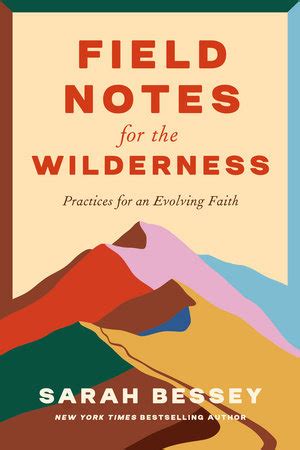
Reading this book eight years ago would’ve been a very different experience for me. In some ways I can see my current self being able to write a similar version of this book with my own stories. Bessey seems to echo a lot of the things I’ve learned and hard-won along the way. But reading through them is still beautiful. Chapter 3 is entitled, “Make Your Peace with This Truth: You Will Change.” She brings up the phrase of being “born again.” But when you strip away whatever trappings or burdensome associations may come with that word, what is left is this notion of constantly being reborn. She writes, “We are born again throughout our lives, becoming new people, starting over with a whole new reality, a new way of being in the world. Sometimes trauma can re-birth us; other times it’s revelation or joy or circumstances. It can be obvious or it can be entirely hidden in our souls” (51).
I love that concept. I know it’s been true in my life. I had acute enough trauma that I now look back and see the me before the cult and the me after the cult. Sometimes the two seem so different I don’t know how to reconcile them, although it’s a journey in process. I was born again after the cult. But it keeps happening in less-dramatic ways. Sometimes I read a book that is so paradigm-altering that I am reborn. Sometimes I emerge from therapy sessions with new insights that have power to drastically change how I approach my current relationships, and I am reborn. Perhaps every time I turn to meditation or centering prayer I have the opportunity to be reborn. We all keep growing and experiencing the world in new ways and being reborn over and over, or at least being offered the chance to.
This phrase “born again” comes from the passage in John 3 where Nicodemus speaks with Yeshua (Jesus).
“Yeshua answered him, ‘Amen, amen I tell you, unless one is born from above, he cannot see the kingdom of God.’
‘How can a man be born when he is old?’ Nicodemus said to Him. ‘He cannot enter his mother’s womb a second time and be born, can he?’
Yeshua answered, ‘Amen, amen I tell you, unless one is born of water and spirit, he cannot enter the kingdom of God. What is born of flesh is flesh, and what is born of the Spirit is spirit. Do not be surprised that I said to you, “You all must be born from above.” The wind blows where it wishes and you hear its sound, but you do not know where it comes from or where it goes. So it is with everyone born of the Spirit.’”
Notice that Yeshua says “unless one is born from above he cannot see…” I think it’s easy to get lost interpreting that “seeing” as arriving, perhaps in a physical place, such as heaven. But I don’t think that’s what Yeshua actually means. I think this being born again a second time has a lot to do with how we see—our perceptions of the spiritual reality. I don’t even think the kingdom of heaven is a physical place, or at least not only a physical place. After reading Jim Marion’s book, Putting on the Mind of Christ: The Inner Work of Christian Spirituality, I’m much more prone to think of the kingdom of heaven as an inward perception. The journey to the kingdom of heaven is an inward one, a journey of reaching higher and higher levels of consciousness until we attain true unity with God and with one another. Marion points out that Yeshua himself states that the kingdom of heaven “was here and now, near, ‘at hand’” (Mark 1:15)) and also “within” (Luke 17:21). It doesn’t mean heaven. It doesn’t mean something for later. Marion writes, “The goal of the spiritual life, Jesus taught, was to ‘seek first’ this inner vision of this world[…] The goal of Christian spirituality, the spirituality that Jesus himself preached, is for each and every one of us to personally be able to see the Kingdom of Heaven within, that Jesus saw. It is for us to go deep enough within our own psyches to find out for ourselves that what Jesus preached was true” (4).
This is complex stuff. I don’t expect you to get it from my probably woefully inadequate summary or explanation. It took me months of reading and years of journeying to catch a taste of it. But what I do feel we can all grasp is that being “born again” has a lot more to do with vision and perspective than it does with any kind of physical transaction or reality. And it’s not a one-and-done act or moment in time. I have zero desire to wade into the weeds of Armenian vs. Calvinistic theology, but I do question the transactional nature of “salvation.” To me a journey with God is a transformational one that takes a lifetime. I have the choice every day whether or not to be reborn. I probably face hundreds of choices whether or not to be reborn in any given day. Will I partner in this transformational journey now? How about now? How about this moment when my child is having a meltdown? How about the moment when I’m needing to manage disappointed expectations? How about now, when I’m mowing my lawn? How about now, when I’m reading to my children? Or writing this blog post? Or doing my dishes? Or sitting quietly with a friend in grief? Or keeping the thought that popped into my head to myself because it won’t benefit the person in front of me on their own journey? You get the point. I could make this list for a long time.
Being born again is about presence and a way of being in the world. It’s about reaching for new lenses each time the one you currently hold gets too scratched or cloudy. We grow out of our current stages of life, and we grow into new ones. And we are reborn and reborn and reborn. Bessey watches this process in her own children. She writes of her eldest daughter, “She’s who she is now and who she will be, and I will remember and love all the old versions of her even as I love the woman she’s becoming. I can’t lock her into who she was once, I have to stay in step with all of her evolution to know and love her well as she grows and becomes herself” (52). Can I cherish the nostalgia of my own children in their tininess, while also releasing those stages so they can grow into the next version of who they are meant to be? Can I do that for myself? Can you do that for yourself? May we each find the grace to welcome rebirth over and over and over again.
References and Resources:
- The Wisdom Pattern: Order, Disorder, Reorder by Richard Rohr
- A podcast from the Center for Action and Contemplation on Parenting: https://cac.org/podcasts/11-parenting/
- “Bullfrogs and Butterflies” by Barry McGuire: https://open.spotify.com/track/0Czt9DXiCieZZuDwAiJfwa?si=9821e6ae16bc4023
- The Wood Between the Worlds: A Poetic Theology of the Cross by Brian Zahnd has been my first layer of evaluating atonement theory. Or his book Sinners in the Hands of a Loving God.
- Field Notes for the Wilderness: Practices for an Evolving Faith by Sarah Bessey
To listen to this post read aloud:
If you’d like to receive my writing delivered direct to your inbox, subscribe below. To contact me with any thoughts, questions, or response, feel free to use the contact form on my website. Be well, beloved.

 Danielle Klafter