The deeper I get into my journey, the bigger God gets. In my childhood I was handed a fairly neat, tidy, and (frankly) small box for God. His character, his theology, and the way he works were explained in straight-forward cut-and-dried ways. And there can be a place for that. Children need more black-and-white, boundaried approaches to life. They need to feel security. It’s a good place to start. But they also need to eventually outgrow this stage. Richard Rohr writes about this in his book, Falling Upward: A Spirituality for the Two Halves of Life. In this book he points out the dangers of how so many of us get comfortable in the first stage and never want to leave. Again, it’s a necessary stage, but if we don’t eventually leave it for something deeper, then we never finish living into the full, breath-taking maturity of our lives that is possible. But that process of moving into the second stage can often be painful.
The past ten years I’ve been shedding theologies, picking some up to examine them closely, setting some back in place, building again. But I’m also finding it’s not about the theology. It’s not about doctrines. It’s more about mystery, and trust. It’s about what I don’t know, about how small I am, and how big God is.
When I first began this process, I began it out of desperation. I encountered pain and spiritual abuse in my life to such a degree that a significant portion of the beliefs and teachings and approaches to spirituality I had been practicing thus far no longer worked for me. I had too many questions. Too many doubts. Too many paradoxes to hold. I broke.
In this stage, doubt was a fearsome thing. What was happening to me? I feared others would judge me as heretical or losing my faith. I stopped going to church, largely because I needed room to wrestle and grieve and say aloud the unspoken doubts swirling in my head. I needed free expression of my pain, time to process my trauma with a skilled therapist. I was afraid of what others thought of me, what they would say if they knew what was going on internally. But I was also scared of the doubts for what they meant to me. Did it mean I was losing my faith? My faith had provided a solid bedrock in my life, the foundation of everything I held dear, the value system I had made my decisions on. But that system had apparently failed me. What now? It felt like the rug was pulled out from beneath my feet. I sprawled on the ground, and I didn’t know what was left.
Many times in the midst of my struggle I wished I could throw in the towel, say “f*** this” and completely walk away from God. It was so painful to stay. It was so much work. It took so much courage and emotional energy to stay. But I did stay. Something in me couldn’t walk away. I knew there was something real enough buried beneath the piles of human fallenness, that I couldn’t just walk away. Somewhere in the middle of that mess, I had a wonderous woman who was listening to my unfiltered journey look me in the eye and tell me, “The wrestling is your faith.” To this day, I am so grateful for those words. The very fact that I was wrestling and asking the questions and not sugarcoating how I felt and not continuing to go through the motions of doing what others expected me to do, yet also not completely walking away, that was my faith. And if I may say so, it was a deeper, more honest version of faith than blindly submitting to whatever strain of doctrine a single church, community, family, or denomination had deemed accurate and worthy. I had to make my faith my own. Doubt was what took me there.
Anne Lamott describes this so poignantly when she writes, “The opposite of faith is not doubt, but certainty. Certainty is missing the point entirely. Faith includes noticing the mess, the emptiness and discomfort, and letting it be there until some light returns. Faith also means reaching deeply within, for the sense one was born with, the sense, for example, to go for a walk.” –Plan B: Further Thoughts on Faith
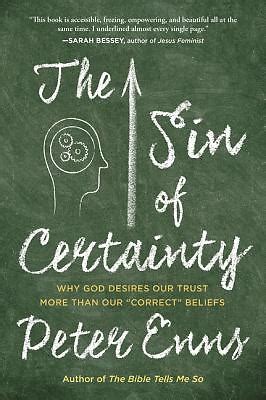
Peter Enns says it this way in The Sin of Certainty, “But doubt is not the enemy of faith, a solely destructive force that rips us away from God, a dark cloud that blocks the bright warm sun of faith. Doubt is only the enemy of faith when we equate faith with certainty in our thinking” (157).
I am so grateful along the way to have found others who recognize this truth and who have been vulnerable about their own process with doubt.
When I’m worn out or tired of the struggle or giving in to fear again, their words give me courage to get up and wrestle through another day. In my own way, I seek to pass on their words to give you courage to face your own version of this messy companion called doubt.
Wilderness
The deepest stages of my wrestling journey lasted around five years. It was a wilderness season. There were a lot of tears, a lot of pain, a lot of questions. God did not feel near in the ways he had in the past. I wondered if I would ever enjoy his presence again. In the language of the mystics, it was my dark night of soul. But at some point, I emerged.
The thing about these dark seasons is that they are transformative. All the faith mystics agree, suffering is the key to transformation. I would argue that doubt is a form of suffering because it requires a lot of dying. It requires looking at something you thought was God, and being willing to recognize you were wrong. Lay it aside. Let it go. Pick up a better view of God, yourself, and the people around you. That takes a ton of humility. It takes a posture that says, I could be wrong. I don’t have all the answers. God is so much bigger than me. I don’t know what to do. I have this theory that there are a lot of faith-filled people who never embark on this journey because it feels too threatening. They’ve invested too much of their lives, their time, their reputation on the version of faith they have. If they open to the possibility that parts of that journey haven’t been what they thought for all these years or decades, what would that mean about their lives? It’s a daunting, harrowing thing to face.
Yet the fruit of those who take this journey is so apparent to me. I’m not talking about those who just get angry and walk away and start bashing religion and never move through their anger to the brokenness on the other side. I’m talking about those who allow their doubt journey to fashion them more in the likeness of their Messiah, the one who was crucified in an act of co-suffering love to draw all human beings to himself. They may have strong opinions or critiques, but they also know they don’t have all the answers anymore, so they tread lightly, recognizing the sacredness of each individual on this journey called faith.
I find my doubts building a lot of humility into my way of being. So often I encounter things now that I don’t know what to do with, but I’m learning to hold them open in my palms, to extend them towards God and say, “I’m holding this. I don’t know what to do with it yet.” Parker J. Palmer calls this living the questions. He wasn’t the first to use that phrase, but he was the first place I encountered it, so I still associate it with him. Live the questions. What does that mean? What does that mean, indeed? That’s the point. Trying to figure that out. I still don’t have clear words for what it means, but I know it means I get up and trust despite my questions. I live into them. I explore them. I work to stay present to myself and God and the people around me while also holding those questions in outstretched hands.
Doubt is not a sign of weakness or something to be ashamed of. It’s not an omen of the death of your faith. It’s an invitation to open and trust. It’s an opportunity to acknowledge that you are part of a mystery that is so large and breathtaking that it will take more than a lifetime to explore it. You will never be done finding the end of God and the divine mysteries that surround him. Those doubts may just be a sign of maturity, an invitation to something deeper and more expansive. They might be the beginning of a necessary death to self, a laying aside of the ego or the false self to find a truer version hidden beneath. To find a truer version of God.
Transformation
I’m still peeling back the layers. The anxiety that accompanied my doubts when I first embarked on this journey has abated. It still flares up on occasion, but now—more often than not—I find this exploratory journey exhilarating. I’m a deep soul and there is so much to explore. What will I find next? How will I set aside childish things next? What else needs peeled back from my ego? What else is ready to open within me? How big will God get in my next layer of peeling back the onion? The possibilities seem endless.
Enns shares: “Doubt means spiritual relocation is happening. It’s God’s way of saying, ‘Time to move on.’ Doubt is powerful. It can do things spiritually that must be done that we would never do on our own. Doubt has a way of forcing our hand and confronting us with the challenge of deeper trust in God, rather than leaning on the ideas we have been holding in our minds about God. Doubt exposes our frail thinking” (157-8).
If any of this describes where you are at, beloved, I would breathe courage into your being. I would say, lean in. Don’t be afraid. And if you are afraid, that’s okay. Hold that out with open hands too. Welcome it. Say, this is where I am right now. Because where you are is on a journey. You are wrestling. You are asking the questions that matter. You have an opportunity for transformation. This is your faith. It’s a beautiful thing. Trust that God is bigger than your doubt. He is holding you. He is not afraid. You are his beloved.

 Danielle Klafter