
Besides re-evaluating my work life, I’ve also been re-evaluating some things about my home life. In late January there was a week I was so out of sorts and dissatisfied and unsure about so many aspects of my life that I swore I was going through a mid-life crisis. And I haven’t even made it to my forties yet.
I spent all of one day considering quitting my job and becoming a Youtuber. Go ahead. Laugh. When I told a friend, that’s what she did. Not at the quitting my job part. “Danielle, you’re not even on social media!” she pointed out. She’s right. It was a bit absurd. When I texted another friend his response was, “Let’s not doing anything drastic quite yet.” I know. Not quite the right idea. But I’m getting there. This blog is a better fit.
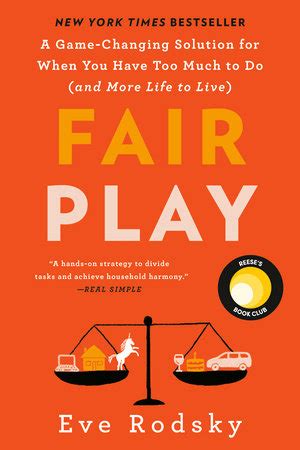
I’ve read another book lately (I know. Shocker!). Fair Play by Eve Rodsky explores the division of labor in the home. The subtitle is A Game-Changing Solution for When you Have Too Much to Do (and More Life to Live). The premise is about making the tasks of running a home and raising children more visible so you and your partner can make more intentional decisions about who does what and why.
When my husband and I got married, I remember having a conversation regarding how I didn’t want to default into stereotypical gender roles. I wanted to make more intentional decisions about who we were and who did what. Guess what? Eight years later it’s been a slow slide into stereotypical gender roles. My resentment at all I carry has been growing.
Over winter break, the girls and Abe were sick for three weeks. The day the kids were healthy enough to go back to school, there was a snow day. And then another. Add two more before the week was out. Between illness, holidays, and snow days, the girls only went to daycare six mornings out of five weeks. Ouch. The HSP (highly sensitive person) in me was screaming. No reset for my overstimulated nervous system. Little ability to complete my prep work for my semester. Aside from his illness, Abe went to work as usual, and I was left to pick up the pieces. I have a job too, but I work from home; so if the girls can’t go to school, suddenly I’m left juggling both, and my self-care goes flying out the window. Rodsky calls this a glitch in the matrix. It’s one of the 100 cards of her fair play deck. It’s a card I fully hold. And I’m wrestling with the question: Am I okay with that? It doesn’t seem fair. Why is it mine? Is it a card I should continue holding by myself? These are the types of issues that Rodsky’s book brings to light.
There is a physical deck of cards that go with the book. 100 physical cards for my husband and I to hold in our hands, discuss, sort, and delegate. You hold this one. I hold this one. This one we’ll trade off week to week. My husband is tactile and visual. Physically sorting through the deck was an enlightening experience for him. We first sorted it according to what each of us was already doing by default.
When we were done, we had removed thirteen cards from our deck. Rodsky encourages getting rid of anything you both deem isn’t necessary or valued in your home. Don’t do more than you must! For instance, in our house Pets and Holiday Cards are two cards we discarded. There was another stack of things that don’t apply in this season, but they might come into play later, things such as an illness, caring for an aging parent, packing school lunches.
- When we were done, there were 87 cards left in play.
- Abe held about 7.
- There were maybe 10-12 we held jointly.
- The rest of the stack was mine.
The physical disparity between our stacks was helpful for my husband to visualize so he could recognize all the mental, emotional, and practical work I do to keep our home going. Our ship runs smoothly and he’s able to do his job well because of all the cards I juggle, but it’s often invisible labor.
Then we started re-negotiating. What are things he can pick up and be successful at? Where can I empower him? Where can I let go of control?
I picked up this book because I was frustrated with my husband’s lack of initiative in helping me. However, as I read the book, I was convicted that at least half or more of our less-than-ideal functioning was my fault. Rodsky asks women to evaluate what kind of person they are, and I recognized myself in the description labeled “My Way or Move Out!” It goes as follows:
“Me: ‘I need some help around here!’
Also me: ‘No, not that like that…here, I’ll do it!’” (123).
Looking into that mirror hurt. How much of our lack of shared collaboration of labor stemmed from my sense of control and needing things to happen a certain way? If I make my husband feel incompetent or incapable of making decisions about how things are going to work, then of course he will want to back off and let me do it. I’m the “expert” and he feels like the “idiot.” So if I want him to step up, I need to empower him. I need to acknowledge there is more than one way to do something. Rodsky outlines that each card has a process called CPE.
Conception of a task.
Planning of a task.
Execution of a task.
If I ask Abe to go to the grocery store but I give him the entire list, send him reminders, make sure he has a quarter for the Aldi cart and take bags to bring home the groceries, then I’ve done the C and P for him. Even if he’s executing the task, I’ve still carried half the load and I’m still holding the card in my deck. Rodsky is a fan of giving cards entirely into the hands of one cardholder. Don’t split up the CPE. Giving my husband the entire card means letting him figure out what to do if he gets to the store and doesn’t have the needed quarter or bags. It means I don’t nag or criticize when he comes home with types of groceries I wouldn’t have bought. It means not expecting him to read my mind and buy something that wasn’t on the shared list. It will be okay if we don’t have cheese sticks. If it’s that important, I can get them another time. Or I can wait and pick them up next week when it’s my turn to hold the grocery card.
Not long after having one of our conversations about our deck of cards, Abe stopped to buy me flowers at Trader Joe’s. He saw a display of noodles, sauce, and chicken sausage and came home and said, “I CPE-ed dinner!” For the first time in I-don’t-know-how-long I came home from a stimulating play date with the kids to dinner already on the table. I hadn’t lifted a finger. It felt wonderful. It wasn’t a dinner I would’ve planned, but it fully met our needs. I need to let go of my control and let him do that more.
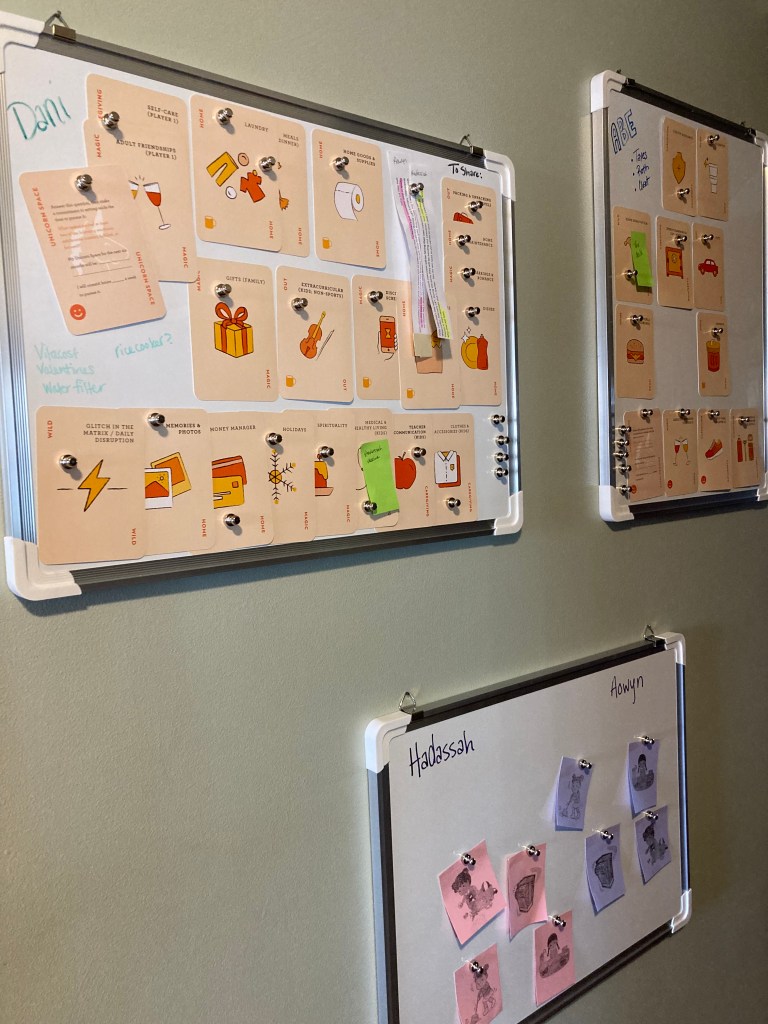
As a practical way to make this ongoing process and weekly re-negotiation more visible, we’ve set up white boards in our kitchen displaying our key cards and the ones we trade back and forth as needed. We made some cards for our kids too, so we call feel included and be able to see our contributions to making our home and family a collaborative place.
Over coffee recently, I was sharing some of my thoughts about this book with a friend. She described the analogy in her own life of thinking of all the cards as balls to juggle. Some of those balls are glass. If you drop them, they will break. It wouldn’t be good if I failed to pay the water bill and our water shut off. Getting some kind of food on the table for my kids at night is a must. But there are others that we sometimes treat like glass balls, when, in reality, they are rubber. They will bounce. If I drop one and don’t get the laundry done today, there won’t be catastrophic consequences. It might pile up, but no one will be harmed. I can afford to drop that ball and pick it up and deal with it another day.
What in your life can you afford to drop or hand off? This post might resonate more with women, but we are all overloaded. If it’s not something in your home, maybe it’s something at your job or how overloaded your schedule has become. It’s always good to re-evaluate and be intentional about what matters most. Our society tends to send us messages every day about how we need to measure up more, about how we’re failing. But what if we’re not failing? What if we just need to stop trying to do everything and focus on what matters most? The point of Rodsky’s book is to make more time for what nurtures you and makes you come alive. I don’t know about you, but I’d like to feel less angry or stressed and more alive.

 Danielle Klafter
One response to “Fair Play: A Self-Assessment and Evaluation of Labor Distribution in the Home”
[…] Fair Play: A Self-Assessment and Evaluation of Labor Distribution in the Home […]